Showing posts with label DYSTOPIAN FANTASY. Show all posts

Sunday, October 1, 2017

Beautiful Adaptation of Modern Classic


Ray Bradbury’s Fahrenheit 451: The Authorized Adaptation by Tim Hamilton

In Guy Montag’s world, firemen have always started fires, not prevented them. Books, declared illegal for the ideas they represent, are promptly destroyed whenever found. Those caught hoarding books are arrested, while their books are burned along with their houses. So what happened when one of these firemen brings a book home out of curiosity? How can he escape from an oppressive society where watching television and popping pills are the only encouraged form of entertainment? First envisioned in Bradbury’s 1953 novel, Hamilton’s adaptation brings this passionate defense of reading and ideas roaring to life. Montag’s surreal, nightmarish world emerges on the page in the form of vibrant ink drawings, with the bold, primary colors of the firemen’s infernos often clashing with the soft, sepia tones of the domestic world. Those who have trouble with Bradbury’s writing style will have no trouble getting through this beautiful adaptation. Recommended for ages 16-Up for mature themes and some violence.

Wednesday, July 6, 2016

"The Bachelor" Meets the Dystopian Fantasy Genre


Source: Author Website
The Selection (The Selection #1) by Kiera Cass (HarperTeen, 2012, 336pp.)

Decades in the future, the United States is no longer a democracy. The government is ruled by a monarchy, social castes are the norm, and teen girls everywhere are obsessed with a government-sponsored competition known as the Selection. This months-long televised event documents the struggle of 35 young women to win the hand of the next prince.

Against this backdrop, America “Mer” Singer, the daughter of poor musicians, reluctantly submits an application for the competition after Aspen, the love of her teenaged life, breaks up with her. She knows that her chances of getting chosen are infinitesimally small, but the promise of a generous stipend, but the opportunity to vault their family into prestige and power, is too much for her ambitious mother to let her pass up.

Against all odds, America’s application gets pulled for the running. She’s not really interested in Prince Maxon, of course. She’s still in mourning for Aspen. So when she sits in for her requisite interview with the prince, she confesses that she’s really only in the competition “by accident,” and really isn’t ready for romance again so soon. To her surprise, Maxon is impressed by her honesty. Instead of sending her home, he makes her a proposal: he will agree to a platonic relationship if she will act as his eyes and ears among the girls. He is, he admits, a bit bewildered by the female sex (especially when they cry!), so any help navigating the waters of this unusual dating environment would be most welcome. Intrigued by his offer, she agrees, and looks forward to helping select the next princess. This arrangement works splendidly for the next few weeks—until her ex, Aspen, gets a job at the palace, and begs her to take him back. This is a major problem, since the Selection rules dictate that any contestant found guilty of “illicit” romantic interloping will be charged with treason and sentenced to death. And then, of course, there’s the unexpected matter of America’s newly developed feelings for Maxon...

I have to admit, for someone who hates love triangles I was surprised by how much I liked this novel. Cass makes a wise decision by keeping America and Maxon’s relationship (mostly) platonic, at least for this first volume of the series. The fact that they get to know each other as friends first, and love interest second, puts their relationship on an interesting level, and allowed me, as a reader, to take their budding romance seriously. In addition, the author manages to bypass most of the requisite melodrama that accompanies love triangles by keeping Maxon and Aspen separated for most of the story—until nearly the end, that is. On the downside, the supporting cast was pretty undeveloped, but I’m hoping that will be amended in the next book. (A final note to potential readers: a lot is set up during this founding installment, but the ending leaves a lot unresolved. If you pick this up at your local library, make sure you have the sequel, The Elite, close at hand.) Recommended for female teens of any age.


Saturday, April 16, 2016

Review Revision: Red Queen by Victoria Aveyard

OK. I was wrong. Red Queen isn’t as terribly awful as my first review claims. My dear readers, I have a confession to make: sometimes I make the mistake of reading and judging a book as an adult writer, instead of considering the literary needs of teenagers. Sometimes, after dashing off a hasty adult-biased review, I’ll find myself thinking about the offending story-world long after I’ve finished the book, and I’ll think, “Maybe I’ll give it another shot.” (This happens more times than I care to admit.)

Red Queen was one of those books. I think the reason why I initially didn’t like it the first time around was due to the novel’s audiobook version. The reader had a perfectly fine voice, but for some reason, every time she took on the condescending tone of one of Mare’s enemies (mainly to say something like, “Watch yourself, little lightning girl”) it drove me up the wall. After suffering through several hours of this, I finally just had to turn off my car’s CD player three-quarters of the way through. Which brings me to my second encounter with the story: not as bad as the first. Instead of the listening to the audiobook again, I checked the book out from the library. Without the reader’s voice in my head, the “little lightning girl” insults didn’t bother me quite so much, and I actually found that I didn’t really mind the love triangle—considering that it doesn’t end like you think it will! By finishing the book, I was also able to learn that Aveyard allows Mare to see that not all Silvers are terrible people, in fact, some of them are kind and generous. She even allows one of the story’s major antagonists to die with a kind of redemptive grace.

However, that does not mean I don’t still stand by some of my original criticisms. The story has obviously been done before: misunderstood heroine, polarized dystopian society, political situation cobbled together from historical events, etc. But you know what? Teens aren’t going to care. The fact that the story reminds me of The Hunger Games isn’t going to bother them. In fact, they’re probably going to be thrilled to find a new favorite read. So, Ms. Aveyard: I’m sorry for giving your book a bad review the first time around. Let’s hope that the sequel doesn’t disappoint!

Monday, July 6, 2015

Another Generic Knockoff of Popular YA Tropes

Source: Publisher Website
Red Queen (Red Queen #1) by Victoria Aveyard (HarperTeen, 2015, 400pp.)

In a distant time and place, people are judged not for the color of their skin, but for the color of their blood. In the dual-class society of Norta, the magic-endowed Silvers rule over the lowly Reds—until a divergence appears in the form of the novel’s sassy, red-blooded heroine. When Mare Barrow defends herself with spectacular powers during a moment of unexpected peril, she draws the attention of the royal family. The royal family, in turn, decides to use her as a propaganda tool to quell their rebellious subjects, and bring her to the royal palace to pass off as a long-lost Silver princess. After Mare reluctantly allows herself to become integrated into Silver society, she is contacted by the Scarlet Guard, a Red rebel group that the Silvers see as a terrorist organization. At great risk to herself to herself, her friends, and her family, she agrees to help the Guard weaken the Silvers' malevolent death-grip.

Now, I am sure that there are hundreds of teen readers out there who are the perfect audience for this book. If you like The Hunger Games, read it! If you like X-Men, read it! If you have a soft spot for generic love triangles, then by all means, knock yourself out. But as to my own opinion as a writer and adult reader? I hated it. I was bored from start to finish, and I’ll tell you why.

Red Queen is nothing more than another knock-off of current popular YA tropes. The writer takes a generic, misunderstood heroine, drops her into a generic dystopian society rife with vague injustices, and then gives her superpowers. Meanwhile, generic high school villains crawl out of the woodworks to bully her. The story itself is powered by events ripped straight from the news and history books. Now, while it’s perfectly okay to model a story from events taken from the news or from history, a good story will be so seamless that the reader won’t be able to take the story apart piece by piece and tell you exactly where everything came from. So, if you dislike love triangles, Mary Sue heroines, and bland villains, steer clear. If you are, in general, an unquestioning fan of romance and dystopian adventure, give it a shot. Just don’t say I didn’t warn you. Recommended for Ages 14-Up.

Monday, June 8, 2015

Great Read; Just Ignore the Flawed Premise

Source: Publisher Website
Wither (Chemical Garden Trilogy #1) by Lauren DeStefano (Simon & Schuster Books for Young Readers, 2011, 358pp.)
 
In the world of Wither, men only live to age 25, while women live to age 20. After they reach those respective ages, each will fall prey to a malicious virus, and because of this, the world is becoming depopulated very quickly. In a frenzy to keep the human race from dying out, polygamy becomes the norm, and incidents of human trafficking go through the roof. “Gatherers” kidnap young girls to sell to the highest bidder. As the story opens, three young women are auctioned off to the wealthy Ashby household. Jenna, age 18, sullenly accepts her fate. Cecily, age 13, has always wanted to be a society wife, and rejoices. But Rhine, age 16, who has been separated from her beloved twin brother, vows to fight and escape by whatever means necessary...even if it means pretending to enjoy her captivity, until someone lets their guard down.

Some reviewers have questioned the validity and science behind the premise: how would a virus automatically kill off EVERYONE at the precise ages of 25 and 20? Why would North America alone survive the desolation of the Earth, while all other continents have been literally reduced to rubble? To which I would reply that yes, they’re correct. It is a flawed premise; the whole narrative is filled with scientific inaccuracies and other implausible details. Would I still recommend this book? Yes! But perhaps I should explain why, since I have criticized quite a few books in the past for their scientific implausibilities. The fact is, I was too swept up in the human aspects of the story to think about the science. The characters are all well-developed, and the villain is believably creepy. So, if that sort of thing bothers you, just skip it. If not, then enjoy the ride! Recommended for Ages 16-Up.

Monday, May 18, 2015

If The Giver Had Been a Romance, It Would Look Like This

Source: Goodreads
Matched (Matched #1) by Ally Condie (Speak, 2010, 416pp.)
 
Seventeen-year-old Cassia Reyes lives in a world where the Society has pre-determined each choice she will ever have to make: where she works, who she marries, how many children she can have, and when she will die. On the night of her Matching Banquet, she is delighted to learn that she has been assigned to her life-long best friend, Xander, and will be granted permission to marry him at age 21 if she so desires. If not, she forfeits her rights to be married, and will automatically take on the irrevocable status of “Single.” At home, she activates the microcard containing her Match’s information—and is stunned to discover that the information on the card is not for Xander, but for Ky, a classmate and mutual friend of theirs. The Society, it appears, has made a mistake. Which boy is she meant to be with? Clever, witty Xander, or quiet, introspective Ky? Although the Matching Department contacts her shortly afterward to apologize for the mistake, Cassia can no longer see things as she once did. Now, she is stuck with the uncomfortable decision of continuing to accept the choices the Society makes for her, or—she can finally make choices of her own.

I have to admit that from reading the summary of this book, I didn’t really have very high hopes for Matched. Thankfully, though, I was quite pleasantly surprised. Far from focusing entirely on the love triangle formed by Cassia’s botched Matching assignment, it also takes time to trace Cassia’s slow journey from blind acceptance to disillusionment of the Society. (It may also be wishful thinking on my part, but perhaps Cassia’s questioning of her Match could also be a way of pushing back against the first-love-at-first-sight element so nauseatingly prevalent in YA romance.) One of the best things about the story, though, is that her two love interests are not just bland hunks of boy-meat that seem to populate YA romance now-days. No, even better: these two boys actually have interesting personalities.

As for any downsides to the novel, the only one I can think of is one that many other readers have pointed out in their reviews: Matched seems to borrow a fair amount from Lois Lowry’s classic novel The Giver (government-assigned jobs, ritualistic euthanasia at a pre-determined age, pre-arranged marital assignments, etc.) While this is unfortunate, I, for one, was not really bothered by it, and frankly can’t think of why teens would be bothered by it either. Recommended for teen girls ages 15-Up.

Monday, September 29, 2014

A Promising Start to a New Dystopian Trilogy

Fire Country (Dwellers/Country Saga #4) by David Estes (Self-Published, 2013, 402pp.)

Scrawny, clumsy, head-in-the-clouds Siena lives in fire country, a land where a long-ago catastrophe caused the sky to turn from pale blue to blood red. The average lifespan is thirty years, and mankind has resorted to polygamy to survive. Young people are required by law to start breeding in their mid to late teens, and every three years, teens are paired with new mates during an event known as the Call. This Law is not to be questioned. Or so Siena thinks. An unlikely heroine, she doesn't even begin to question her prescribed role in life until a few months before her Call ceremony. As she prepares to consider her preordained fate as a soon-to-be Bearer, a classmate, Lara, suggests the unthinkable: what would happen if young women rebel against the status quo?

Estes has created a memorable heroine in Siena in this first volume in the Country Saga (sister series to the Dwellers Saga). Although some of the concepts he explores here are a bit cliche (the fire country tribes are too much like Native Americans in some aspects, while their enemies, a notoriously feral all-female tribe, are too much like Amazons), Fire Country still proves to be a promising start to a new dystopian trilogy.

Tuesday, March 25, 2014

Sets the Bar High for Other Books by Estes

The Sun Dwellers (The Dwellers/Country Saga #3) by David Estes (Self-Published, 2012, 398pp.)

The Sun Dwellers finds Adele, Tristan, and the gang setting off on a mission to kill the egomaniacal Sun Dweller President Nailin and end a war that is wreaking havoc in the Lower Realms. By the end of the story, there will be more death, more innocence lost, and an awesome secret revealed that changes everything.


What can I say? It’s a good book. The pacing is quick, the tension is almost painful, and the ending climax is pretty epic. That said, like the other books in this series, it isn’t great. The author gets a little heavy-handed at times about the socioeconomic disparities between the Sun Realm and the Lower Realms, and certain supporting characters remain as flat as they were the moment they entered the story. That said, it’s still a very good end to The Dwellers Saga, and sets the bar pretty high bar for its sister series, The Country Saga. Recommended for Ages 15-Up.

Monday, March 10, 2014

A Satisfactory Second Installment

The Star Dwellers (The Dwellers/Country Saga #2) by David Estes (Self-Published, 2012, 374pp.)

By the end of The Moon Dwellers, heroine Adele has busted out of juvie with her new friends, Cole and Tawni, saved her little sister, Elsey, from an orphanage, reunited with her renegade father, Ben, and has finally met up with her love interest Tristan, the Sun Dweller president’s rebellious son. In the beginning of The Star Dwellers, the group has been scattered. Cole has been killed by Sun Dweller forces. Adele and Tawni have embarked on a mission to spring Adele’s mom from the Star Realm prison, while Tristan and Adele’s family work with the Resistance to convince the Star and Moon Realms to unite against the Sun Realm.

Overall, The Star Dwellers is a very satisfactory installment. Since I normally roll my eyes at teen romance, I was pleased to see that the lead couple (Adele and Tristan) show their maturity by focusing on their various missions, rather than mooning over each other’s absence. Some of the supporting characters, like Tawni, still remain a little flat, but I’m hoping that this will be amended in later installments. Recommended for Ages 14-Up.

Wednesday, October 30, 2013

A Good Introduction To Science Fiction For Teens

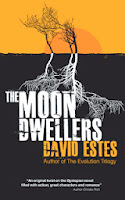
The Moon Dwellers (The Dwellers/Country Saga #1) by David Estes (Self-Published, 2012, 366pp.)

In the first volume of David Estes’s Dwellers/Country Saga, Earth as we know it is over. Due to an environmental cataclysm, people have been forced underground. Now, people live in what’s known as the Tri-Realms. The luckiest live in the Sun Realm (closest to the Earth’s surface) alongside the likes of the system’s dictator-president, Edward Nailin. The not-so-lucky middle-class are stuck in the Moon Realm with terrible living conditions, while the truly desperate are forced to live in the Star Realm, the deepest level of them all. Told from the points of view of its two teenage narrators, the novel chronicles the plight of middle-class waif Adele Rose and Tristan Nailin, the president’s rebellious son, two strangers who are surprised when a chance-glimpse of each other seems to awaken a peculiar connection between them.

The YA genre could definitely use some good science fiction, and The Dwellers/Country Saga is a good place to start. While the action is non-stop, the world-building pretty thorough, and the pacing consistent, the characters, unfortunately, were not given equal chance to develop at the same rate as these other factors. Aside from that, though, it really does make for some exciting reading: with action and love at first sight, there’s enough here to attract both male and female teens. Recommended for Ages 15-18.

Tuesday, June 4, 2013

The Tree House


The Tree House by Shay Lynam (Self-Published, 2013, 272pp.)

***Spoilers are present.***

When two mysterious gunmen break into Hailey’s house and try to kidnap her, she just barely manages to avoid capture by fleeing into the maze of downtown Seattle. As the armed agents close in, she runs into a young man named Jack, who not only helps her escape, but also knows why she’s being pursued. Enter Sy, Jack’s superior, and the other members of the Tree House. What is the Tree House, you ask? Well, it’s certainly not the condemned building it seems to be (even though it does have a tree growing through its cement floor). Those who live in the Tree House are survivors—just like Hailey—in a massive science experiment gone awry.

Back in the 1990s, E. Scott Pharmaceuticals, headed by medical genius Eli Scott, experimented with newborns around the world that had been infected with neonatal tetanus, a disease contracted by infants when they are born into a non-sterile environment. To solve the problem, the company inserted a microchip into the infants’ brains in order to fight off the infection. Then, instead of sending the children back home to their parents, they were placed in the care of foster families so the company could monitor their progress. When something about the experiment went drastically wrong, the company made the decision to scrap both the project and its test subjects (hence, the chase-scene).

While The Tree House has plenty of action and romantic tension, the characters are flat, and the premise itself is, I’m sorry to say, illogical. Why would anyone use microchips to fight off tetanus? It’s a bacteria. There’s a shot for it. If there has to be experimental microchips involved, why not have the company focus on something neurological, like Parkinson’s? Also, why the need for secrecy? If the company is breaking human rights laws, why perform these experiments in the United States? Why not hold them in a third world country with where people can be bribed to look the other way? The Tree House is a problematic novel that still needs a lot of work, and is unfortunately one that I can’t really recommend to readers at this time.

Click on cover for image source.

Thursday, October 25, 2012

Will Appeal to Fans of "The Hunger Games"


The Forsaken (The Forsaken Trilogy #1) by Lisa M. Stasse (Simon & Schuster Books for Young Readers, 2012, 384pp.)

This latest offering in the YA dystopia genre covers the adventures of Alenna Shawcross, a shy, quiet teen citizen of the oppressive United Northern Alliance. Her story begins after she fails the national Government Personality Profile Test and is banished to Island Alpha, a dumping ground for social undesirables and political dissidents. Every child in the UNA grows up hearing horror stories about Island Alpha, that it’s a prison colony populated by violent sociopaths—and that the average life expectancy is 18. Imagine her surprise, then, when she discovers that the other island inhabitants are, for the most part, just normal kids like her. But Island Alpha has a reputation for a reason. There are bad kids, too. The Drones, a chaotic horde of teens who really are violent and anti-social, are constantly on the prowl. What’s more frightening than the Drones themselves is their almost rabid devotion to a mysterious figure known as the Monk. Containing elements of intrigue, suspense, and romance, The Forsaken reads like a kind of futuristic version of Lord of the Flies—except it’s much more accessible, entertaining, and appealing than LOTF will ever be. Recommended for Ages 16-18, and fans of The Hunger Games.

Saturday, March 3, 2012

An Amazing YA/Crossover Novel

Source: Author Website
Pure (Pure #1) by Julianna Baggott (Grand Central Publishing, 2012, 448pp)
“We know you are here, our brothers and sisters. We will, one day, emerge from the Dome to join you in peace. For now, we watch from afar, benevolently.”
Nine years after the earth is devastated from an atomic blast, the remains of civilized society huddle under a dome that overlooks a wasteland. Those who live outside the Dome are horribly disfigured mutants who live on a hand-to-mouth existence. When Partridge Willux, the next-in-line for leadership of the Dome, escapes into the poisoned wasteland to look for his mother, he meets a young mutant girl named Pressia. Together, the two begin a journey that leads them to an unexpected destiny. Pure, the first is a trilogy, is an amazing, imaginative novel with excellent world-building details and character development. Recommended for Ages 16-18, but will also appeal to adults with an interest in dystopian fiction and science fiction.