Showing posts with label SCIENCE FICTION. Show all posts

Thursday, March 1, 2018

An Excellent Space Opera from Divergent Author Roth


Carve the Mark (Carve the Mark, #1) by Veronica Roth

On the frozen planet of Thuvhe, both native Thuvhesits and their conquerors, the Shotet, worship the universal current that blesses them with current-gifts. Shotet warrior-princess Cyra Noavek’s deadly talent is used by her ruthless brother, Ryzek, to torture his enemies—a gift that also leaves her in constant, excruciating agony. When Ryzek hears that Akos, a Thuvhesit farm-boy, can neutralize the current-gift of others, he removes him from his family and brings him to the palace to act as companion and cure-all for Cyra. As the two grow from reluctant acquaintances to fast friends, a flurry of activity from the surrounding cast of characters slowly drives the plot forward, culminating in a revolt against Ryzek’s power. 

Veronica Roth’s latest is a lot to take in, and is as different from her bestselling debut, Divergent, as day is from night. While Divergent is a flawed dystopian tale, an obvious first novel told by a talented yet inexperienced novice, Carve the Mark is something else entirely. It’s a soaring space opera peopled by complex characters, with a believable story-universe made all the more real by intricate world-building details. The action is a bit slow to build, but since the author takes pains to establish necessary backstory before moving on to the real meat of the narrative, this is a forgivable flaw. The verdict: while Divergent fans may not find this latest work to their liking, fans of space operas will definitely love it. Recommended for Gr 9 Up for violence and language.

Sunday, October 1, 2017

Almost as Good as the Original Classic


Mary Shelley’s Frankenstein: The Graphic Novel by Gary Reed, with art by Frazer Irving

Reed and Irving deliver a clear, straightforward adaptation of Shelley’s classic novel that older children will be able to both enjoy and understand. Soft, surreal, black and white illustrations set the stage for this gripping, elegant narrative. Facial expressions are never dull, and at times border on the melodramatic. The centerpiece of this work is the Monster himself – towering and lanky with long, disproportional limbs, this creature is dark and frightening, yet expressive and laden with undeniable human thoughts and emotions. Part of the Puffin Classic Graphics series, this graphic adaptation is one that can certainly stand apart from the original. Recommended for Gr 7 Up.

Beautiful Adaptation of Modern Classic


Ray Bradbury’s Fahrenheit 451: The Authorized Adaptation by Tim Hamilton

In Guy Montag’s world, firemen have always started fires, not prevented them. Books, declared illegal for the ideas they represent, are promptly destroyed whenever found. Those caught hoarding books are arrested, while their books are burned along with their houses. So what happened when one of these firemen brings a book home out of curiosity? How can he escape from an oppressive society where watching television and popping pills are the only encouraged form of entertainment? First envisioned in Bradbury’s 1953 novel, Hamilton’s adaptation brings this passionate defense of reading and ideas roaring to life. Montag’s surreal, nightmarish world emerges on the page in the form of vibrant ink drawings, with the bold, primary colors of the firemen’s infernos often clashing with the soft, sepia tones of the domestic world. Those who have trouble with Bradbury’s writing style will have no trouble getting through this beautiful adaptation. Recommended for ages 16-Up for mature themes and some violence.

Monday, February 15, 2016

"Strings" Blog Tour


Hello, all! I am pleased to participate in the Blog Tour for David Estes' newest novel, Strings, a great dystopian retelling of the classic tale, Pinocchio. Instead of a wooden puppet, Pia is a resilient, spunky teen who fights for the freedom to make her own choices, and ultimately, decide who she is on her own terms. I’m going to go ahead and recommend this one for all teens, because it’s all-around entertaining, and has a little of something for everyone: mystery, romance, intrigue, you name it. I also would like to suggest it for fans of Cinder, and other like-minded dystopian fairy tales. 

Also included are several excerpts, and other fun links.


Synopsis
“A wonderful retelling of the Pinocchio story...I simply couldn’t put this book down.” Rysa Walker, bestselling author of TIMEBOUND
Sometimes the strings that tie us down are the same strings that set us free.

Sixteen-­year­-old Pia has always lived in a mysterious facility where mechanical strings control her existence. She plays apprentice to her father, Gio, in performing nanotech designs for the Company, and she soon suspects there are diabolical human forces behind the manufactured reality of her world.

Though her childhood memories and the origins of the strings remain strangely elusive, she begins to find solace with the introduction of two unlikely friends: daring, irrational Sofia, and calm, tender Marco.

As the truths of the past and present unravel together, Pia must find a way to free herself from her strings and escape the facility before facing the wrath of the unstable head of security, Mr. Davis. But to gain her freedom, she must navigate the dangers posed by Davis and by her suspicious new friends to find the real identity of the puppeteer.

If Pia can succeed in revealing the secrets of the Company, she may very well find the independence she so desperately seeks. But in her controlled world nothing is as it seems, and the closer she gets to the truth, the graver the consequences.

Goodreads


EXCERPTS FROM STRINGS 

Excerpt 1
The strings are as black as polished ebony, twirling down from the viscous ceiling, which moves like dark waters lapping on a bleak and empty shore. Almost like it’s breathing: in and out, in and out. Not solid, but molten like lava; the dark ceiling flows from room to room throughout the entire compound, allowing my strings to move gracefully and unfettered without getting tangled. According to Papa, the gelatinous ceiling was invented late in the 21st century under the name dream oil. Basically the thick liquid substance can float within designated electromagnetic fields (like a rectangular ceiling space) and yet create enough internal friction to secure various fixtures, such as lights or ceiling fans (or strings). The ceiling controls the strings, sometimes seeming to read my mind before even I know what I’m thinking. Pulling me right when I’m about to turn left. Raising my hand when I’m about to drop it to my side. Bending me to its every will and whim, which most of the time feels like exactly the same thing.

The strings are connected to me in fifteen obtrusive places. One in each thumb, one in each hand, one in each foot. My elbows and knees are connected, too. One in each hip and shoulder for balance, and one final string plugged into the crown of my head, forcing me to look people in the eyes, even if I don’t want to. There are thin silver circles implanted in my flesh where each string enters my skin. As far as I can tell, there’s no way to pull the strings out, unless some kind of special tool is required. So long as I do what’s expected of me, the strings mostly leave me alone, sort of like they’re a part of me, moving as I move, staying out of my way. But if I veer off course for even a second, they’re always there to pull me back in line; I’m a marionette maneuvered by a skillful and indifferent puppeteer, jerking me
around without regard for the pain it causes.

Like the mangled scissors I tried to cut my strings with, I’m bent. Not literally—my strings are as taut and tight as ever—but inside, where no one can see. I’m bent like a cracked toothpick.

Bent.

But not broken.

Excerpt 2
Happiness is perched on a branch outside my window.

A robin, resting in a nest with two blue eggs, their matte curves as perfect and unmarred and cloudless as a cornflower sky. The mama bird has been tending to her unborn babes for days, keeping them warm. I can’t wait to see them hatch.

Watching the bird and her eggs each morning while braiding my hair is my moment of peace. It’s a single pinprick moment where I can forget the world and smile without letting reality ruin things.

I often imagine that my window is on hinges, and that I can push it open,reaching my hand into the empty expanse, feeling the breeze on my skin, offering friendship to the robin and its family. The mama would land on my arm and cock her head and sing songs of life to me. She would change me with her melodies.

But the window is just a slab of thick glass, slightly blurring the view that is already ruined by the hardy metal bars rising from sill to ceiling.

A prison.

Our home.

Excerpt 3
I see it.

A few steps away, closer than my father’s station: the door to the outside. The guard has gotten lazy, having left the door ajar, a sliver of outside sunlight burning an orange stripe across the floor.

Without thinking, I race for the opening, feeling my strings tense a moment too late, for once not anticipating my move—probably because of how insane it is. My hands are battering rams, shoving the door open, reaching for the sunlight. My body goes rigid as the guard barks, “Hey!” and I feel a monstrous force grab my hands, my feet, my shoulders, my hips, and my head, thrusting them in reverse. I’m airborne, flying back inside, the room a blur of equipment and bright walls and a dark, swirling ceiling, and my father’s eyes—wide and white with fear.

My body hits the floor with a vicious thud that jars my bones and rattles my teeth, which should be punishment enough.
It’s not.

The strings are livid, no longer black, pulsing with red, like blood rushing through a needle. They snap at my skin, cracking like whips—and when they connect they’re like severed electrical wires, sending shocks through my core, to my extremities, to the deepest, darkest, most hidden parts of my soul.

And through my blurry, tear­-filled vision, I can see past my father, who’s struggling fruitlessly with the guard, trying to get to me. My heart sinks.

Because the box on the screen is displaying a single sentence:

Message sent.

Darkness folds its silky wings around me.

Excerpt 4
I am not a picture. You can’t frame me and fasten me to the wall and stare at me. You can’t just turn me around when you don’t want to look at me. I’m not a thing. I’m not. Right?

Right?

Is anyone listening to me?

The harshest lies are the ones we tell ourselves.

The truth is, I am a doll. When I’m not being used they stick me on a shelf to gather dust. They take me down to play with me, pulling my arms and legs in ways they’re not meant to go. Ways I don’t want them to go. My actions are not my own. My life belongs to those who control my strings. I am a doll with a stitched mouth, melancholy but exhausted beyond true sadness.

Sometimes I feel like even less; like I’m not a real girl. Like I’m more like Fig than I thought, someone’s creation. Used, tired of, and eventually thrown out. What is real? Am I real if my body is not my own? Am I real if I have no right to choose my own destiny?

No.

The answer is no.

I’m just somebody’s thing, a marionette dancing on strings so strong they might as well be steel cables. We’re both puppets in a street show, my father and I.

Excerpts 5
“My mother told me a story when I was little. It was my favorite story, about a lion. I didn’t remember it before, but I do now.”

Marco blinks, raises his eyebrows. This is clearly not what he was expecting.

“The lion was the son of the King of the Pride, destined to one day be the new king. The only problem was that the poor lion couldn’t roar. The other lions teased him relentlessly about his failings. ‘How can a lion with no roar be a king?’ they would mock. The lion’s only companion was a beautiful young lioness who didn’t care about his lack of a roar. ‘You are who you are,’ she would say, ‘and I like you this way.’ Much to his father’s disappointment, the lion spent more time with her than with the other lions.

“Ashamed of the son he’d created, his father eventually felt he had no choice but to cast his own son out of the Pride, instructing him not to return without his roar. ‘Don’t fail me, Son,’ he said. He didn’t give his son the chance to say goodbye to the lioness.

“For days, the lion wandered aimlessly, foraging for food and seeking his roar in the dark places of the world. He encountered moments of fear, of anger, of beauty, but still he remained silent, his ferocious mouth opening and closing soundlessly with each new experience.

“Until, one day, when by chance alone, his journey brought him full circle, back to his old Pride’s territory. High on a cliff, he watched them, shocked and amazed at how things had changed. His father was old and weak, and his mother was gone. The beautiful lioness was still there, but she was missing the spark he used to love in her big brown eyes.

“His sadness was so complete, so real, that he opened his mouth and bellowed, a mournful roar of melancholy and regret, so loud the entire Pride looked up to see him.”

When I finish the story, I realize Marco is staring at me while I stare off into space, still visualizing the lion and his Pride. “Then what happened?” he asks.
“I—I don’t know,” I say. “My mother always stopped there.”

“I don’t understand,” Marco says. “Did the lion become King of the Pride? Did he marry the lioness?”

I shrug. “I guess that’s for us to decide.”

“Why did the lion have to be so sad to roar?”

I look at him, lost in his gaze. “Sometimes we have to fall all the way to the bottom before we can rise to the top,” I say, quoting my mother’s words.

He nods, although I can’t tell if he really understands. I dance my fingers over to his, and link our pinkies. His eyes flash with surprise. “You feel nothing, right?” he says, the edge of his lip curling.

I grin back. “Honesty is a story about a lion,” I say. “Now, Marco, will you roar with me?”

He frowns. “What?”

“Roar with me.”

“Why?”

“Because we can,” I say.

“I’d feel foolish.”

“Don’t you ever do anything foolish?”

“I try not to. Why would I?”

“Because we’re human,” I say. “No one is watching us here, right? There’s no creepy black ceiling, no cameras, no one to feel silly in front of.”

“You’re here.”

“So what? We’ll both roar. C’mon. Just do it. Roar.”

“When?”

“Now. On the count of three. One, two—”

“Wait. I’m not ready.”

I roll my eyes. “One, two, three!”

I stay silent, listening to Marco’s pathetically awkward attempt at a roar, unable to hold back my laughter. “You call that a roar?”

“You tricked me. You said we’d roar together.”

“No, I said we’d both roar, but I never said we’d roar at the same time.”

He shakes his head. “I must’ve missed the difference.”

I roar, as loud as I can, filling the empty room with noise, relishing the way he flinches in surprise. “Did I scare you?” I ask, after I finish.

He roars. It’s a lot better than the last one, maybe even as good as mine, an ear­-rending growl of freedom. Although his roar is resounding in my ears, I’m fixated on his hand, which is now entwined with mine, our fingers linked, our knuckles turning white.

When he stops, he says, “Better?” and I say, “Much,” and then we both open our mouths as wide as we can and roar together.

We don’t stop until our throats are raw and our mouths are dry and we can’t stop smiling.

Purchase Links
Rafflecopter Giveaway


About the Author

David Estes is the author of more than 20 science fiction and fantasy novels that have received hundreds of thousands of downloads worldwide, including The Moon Dwellers, Fire Country, Slip, Brew, and his new SciFi Pinocchio retelling, Strings. He lives in Hawaii with his inspiring Aussie wife, Adele, rambunctious son, Beau, and naughty cat, Bailey. When he's not writing, you'll likely find him at the beach swimming, snorkeling, or reading under an umbrella.


Author Links

Facebook
Goodreads
Tumblr
David's blog
Twitter
Instagram
David's official fan group


Monday, June 22, 2015

A Smart Sci-Fi Tale with a Feministic Twist

Source: Author Website
Salvage (Salvage #1) by Alexandra Duncan (Greenwillow Books, 2014, 528pp.)

On the deep space merchant ship Parastrata, polygamy is the norm, women are second class citizens, and traditional gender roles are strictly enforced. When Ava, an unmarried teen, choses to give her virginity to the boy she loves rather than waiting for a husband of her family’s choosing, she is banished from the only home she’s ever known. Ava knows she cannot survive on her own, so she decides to travel Earth-side to find her mother’s long-lost half-sister. Along the way, she gains a new sense of self-awareness, and learns some hard lessons that challenge the conservative values she was raised with. A smart sci-fi tale with a feministic twist, Salvage is recommended for Ages 16-18, particularly for fans of Wither and other girl power-themed stories.

Monday, September 29, 2014

A Promising Start to a New Dystopian Trilogy

Fire Country (Dwellers/Country Saga #4) by David Estes (Self-Published, 2013, 402pp.)

Scrawny, clumsy, head-in-the-clouds Siena lives in fire country, a land where a long-ago catastrophe caused the sky to turn from pale blue to blood red. The average lifespan is thirty years, and mankind has resorted to polygamy to survive. Young people are required by law to start breeding in their mid to late teens, and every three years, teens are paired with new mates during an event known as the Call. This Law is not to be questioned. Or so Siena thinks. An unlikely heroine, she doesn't even begin to question her prescribed role in life until a few months before her Call ceremony. As she prepares to consider her preordained fate as a soon-to-be Bearer, a classmate, Lara, suggests the unthinkable: what would happen if young women rebel against the status quo?

Estes has created a memorable heroine in Siena in this first volume in the Country Saga (sister series to the Dwellers Saga). Although some of the concepts he explores here are a bit cliche (the fire country tribes are too much like Native Americans in some aspects, while their enemies, a notoriously feral all-female tribe, are too much like Amazons), Fire Country still proves to be a promising start to a new dystopian trilogy.

Friday, May 2, 2014

Zein

Source: Author Website
Zein: The Prophecy (Zein #1) by Graham J. Wood (New Generation, 2014, 334pp.)

Zylar of the Zein race plans to destroy all who oppose him in his quest to occupy the earth. His purpose in doing so is to wipe out humanity and strip the planet of its zinithium, a rare element currently unknown to mankind, but highly prized by the Zein.

Zylar is not without opposition, however. A prophecy speaks of two brothers that will defeat him: Kabel Blackstone, the nephew hidden from Zylar at birth, and Tyson Mountford, Kabel’s human half-brother. Together, these three characters lock in a deadly struggle that will determine the fate of the earth.

I have to admit that while I love science fiction, this YA novel wasn’t quite my cup of tea. Although the action is non-stop, the novel favors plot development at the expense of character development, and I found it hard, at times, to feel gripped by the characters’ plight. Due to suggestive content and violence, Zein: The Prophecy is recommended for older teens, Ages 16-Up.

Tuesday, April 15, 2014

Division


Divison by Karen A. Wyle (Self-Published, 2014, 350pp.)
In the distant future, Johnny and Gordon Blake, conjoined twins, are living a quiet existence with their friends and family. Gordon is perfectly happy with their lives. Johnny is not. When a revolutionary new cloning procedure is invented, allowing persons to safely have their brains transplanted into new bodies, Johnny is eager to get a body of his own so he can live his own independent life. He resorts to legal measures to have himself emancipated from the body he shares with his twin, and threatens to destroy his family’s happiness and security.

While a bit unusual, it’s definitely a great story. I have no idea if the science fiction elements here are valid, but that’s not the novel’s real focus. While the twins’ physical condition may not be something that everyone can relate to (after all, the condition is rare), the story’s implications are definitely universal. Division highlights the struggle between the comforting and confining nature of familial closeness, and the natural adolescent urge for personal space and independence. A YA/adult crossover novel recommended for Ages 16-Up.

Tuesday, March 25, 2014

Sets the Bar High for Other Books by Estes

The Sun Dwellers (The Dwellers/Country Saga #3) by David Estes (Self-Published, 2012, 398pp.)

The Sun Dwellers finds Adele, Tristan, and the gang setting off on a mission to kill the egomaniacal Sun Dweller President Nailin and end a war that is wreaking havoc in the Lower Realms. By the end of the story, there will be more death, more innocence lost, and an awesome secret revealed that changes everything.


What can I say? It’s a good book. The pacing is quick, the tension is almost painful, and the ending climax is pretty epic. That said, like the other books in this series, it isn’t great. The author gets a little heavy-handed at times about the socioeconomic disparities between the Sun Realm and the Lower Realms, and certain supporting characters remain as flat as they were the moment they entered the story. That said, it’s still a very good end to The Dwellers Saga, and sets the bar pretty high bar for its sister series, The Country Saga. Recommended for Ages 15-Up.

Monday, March 10, 2014

A Satisfactory Second Installment

The Star Dwellers (The Dwellers/Country Saga #2) by David Estes (Self-Published, 2012, 374pp.)

By the end of The Moon Dwellers, heroine Adele has busted out of juvie with her new friends, Cole and Tawni, saved her little sister, Elsey, from an orphanage, reunited with her renegade father, Ben, and has finally met up with her love interest Tristan, the Sun Dweller president’s rebellious son. In the beginning of The Star Dwellers, the group has been scattered. Cole has been killed by Sun Dweller forces. Adele and Tawni have embarked on a mission to spring Adele’s mom from the Star Realm prison, while Tristan and Adele’s family work with the Resistance to convince the Star and Moon Realms to unite against the Sun Realm.

Overall, The Star Dwellers is a very satisfactory installment. Since I normally roll my eyes at teen romance, I was pleased to see that the lead couple (Adele and Tristan) show their maturity by focusing on their various missions, rather than mooning over each other’s absence. Some of the supporting characters, like Tawni, still remain a little flat, but I’m hoping that this will be amended in later installments. Recommended for Ages 14-Up.

Wednesday, October 30, 2013

A Good Introduction To Science Fiction For Teens

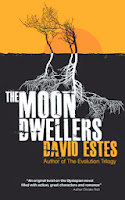
The Moon Dwellers (The Dwellers/Country Saga #1) by David Estes (Self-Published, 2012, 366pp.)

In the first volume of David Estes’s Dwellers/Country Saga, Earth as we know it is over. Due to an environmental cataclysm, people have been forced underground. Now, people live in what’s known as the Tri-Realms. The luckiest live in the Sun Realm (closest to the Earth’s surface) alongside the likes of the system’s dictator-president, Edward Nailin. The not-so-lucky middle-class are stuck in the Moon Realm with terrible living conditions, while the truly desperate are forced to live in the Star Realm, the deepest level of them all. Told from the points of view of its two teenage narrators, the novel chronicles the plight of middle-class waif Adele Rose and Tristan Nailin, the president’s rebellious son, two strangers who are surprised when a chance-glimpse of each other seems to awaken a peculiar connection between them.

The YA genre could definitely use some good science fiction, and The Dwellers/Country Saga is a good place to start. While the action is non-stop, the world-building pretty thorough, and the pacing consistent, the characters, unfortunately, were not given equal chance to develop at the same rate as these other factors. Aside from that, though, it really does make for some exciting reading: with action and love at first sight, there’s enough here to attract both male and female teens. Recommended for Ages 15-18.

Tuesday, June 4, 2013

The Tree House


The Tree House by Shay Lynam (Self-Published, 2013, 272pp.)

***Spoilers are present.***

When two mysterious gunmen break into Hailey’s house and try to kidnap her, she just barely manages to avoid capture by fleeing into the maze of downtown Seattle. As the armed agents close in, she runs into a young man named Jack, who not only helps her escape, but also knows why she’s being pursued. Enter Sy, Jack’s superior, and the other members of the Tree House. What is the Tree House, you ask? Well, it’s certainly not the condemned building it seems to be (even though it does have a tree growing through its cement floor). Those who live in the Tree House are survivors—just like Hailey—in a massive science experiment gone awry.

Back in the 1990s, E. Scott Pharmaceuticals, headed by medical genius Eli Scott, experimented with newborns around the world that had been infected with neonatal tetanus, a disease contracted by infants when they are born into a non-sterile environment. To solve the problem, the company inserted a microchip into the infants’ brains in order to fight off the infection. Then, instead of sending the children back home to their parents, they were placed in the care of foster families so the company could monitor their progress. When something about the experiment went drastically wrong, the company made the decision to scrap both the project and its test subjects (hence, the chase-scene).

While The Tree House has plenty of action and romantic tension, the characters are flat, and the premise itself is, I’m sorry to say, illogical. Why would anyone use microchips to fight off tetanus? It’s a bacteria. There’s a shot for it. If there has to be experimental microchips involved, why not have the company focus on something neurological, like Parkinson’s? Also, why the need for secrecy? If the company is breaking human rights laws, why perform these experiments in the United States? Why not hold them in a third world country with where people can be bribed to look the other way? The Tree House is a problematic novel that still needs a lot of work, and is unfortunately one that I can’t really recommend to readers at this time.

Click on cover for image source.

Monday, November 26, 2012

Kadamba of Gentle Humilaith


Kadamba of Gentle Humilaith (Cosmic Library #2) by Mirti Venyon Reiyas (CreateSpace, 2012, 132pp.)

This second stand-alone installment in Reiyas’s Cosmic Library series deals with the effects of the malicious Thorn Virus spawned by the mischievous kinkas, a malignity which is gradually suffusing the universe—both people and things—with ill-will and unscrupulous behavior. On planet Ethera, Kon Fu-Zed, the ambitious director of an aerospace travel company, has plans to develop the previously untouched continent of The (pronounced “thay”) into an animalline-hunting theme park. He also can’t wait to try out his brand new invention, the “Whe-pin,” a devastating weapon which would be the nightmare of any endangered species. He appoints Tahdi Bellevue, an employee, to lead a surveying expedition. But when Tahdi lands on The, he meets Neelaiyahay, a half-tiger, half-human being who opens his eyes to the ecological consequences of Kon Fu-Zed’s plans. In the end, Tahdi and Neelaiyahay must defeat not only the physical manifestation of the thorns (which are clogging up inter-dimensional gateways), but convince Kon Fu-Zed that razing everything green to the ground is not beneficial to anyone in the long run.

As I finished Kadamba, my initial reaction was: “Well, that was okay. Things certainly happened, but at the same time, the events weren’t very...dramatic.” Then I  remembered seeing something on the author’s website about the name she has assigned for this particular genre: “Positive Young Adult Romantic Adventurous Fantasy.” Ah, I thought. That explains it. The Cosmic Library series is one that keeps the conflict on a juvenile reader’s level while exploring interesting ideas. There are no cars and trucks exploding, nor people massacring their families and then setting themselves on fire. The series shuns violence, and instead choses to focus on the importance of choosing the path of positive thinking over that of negative (if you’ve ever taken a yoga class, you’ll know what I’m talking about).

Now, some of the best psychological fiction has no “action,” but instead mediates on the characters’ internal struggles. In this regard, however, Kadamba loses some points. Although I liked the relationship between Tahdi and Neelaiyahay, I didn’t feel like I got to know them, or the other characters, as well as I could have. Recommended for Ages 12-14, and for adults who are tired of the graphic violence in the media.

Click on cover for image source.