Showing posts with label Any Teen (13-18). Show all posts

Monday, June 29, 2015

Happy-Go-Quirky Tale of Gay Adolescence Will Appeal to Any Age

Source: Author Website
Boy Meets Boy by David Levithan (Knopf Books for Young Readers, 2003, 192pp.)

Narrated by Paul, a gay teen, this happy-go-quirky tale chronicles one academic year at a very non-conventional high school, where the quarterback/homecoming queen is a transvestite named Infinite Darlene, the cheerleaders ride Harleys, and being straight-out gay is perfectly okay. But even in this oasis of tolerance, Paul still has ordinary teenage problems. First, he starts dating Noah, a quiet, artistic newcomer at school, but finds that he may still have feelings for his ex, Kyle. Then, his best female friend, Joni, starts dating not-so-nice-guy Chuck, and begins drifting away from their close-knit circle of friends. What's a boy to do? A treasured classic in the LGBT community, Boy Meets Boy is a funny, touching story about acceptance of self and the true love our friends and family give us, despite the stupid mistakes we make. Recommended for all walks of life, Ages 13-Up.

Monday, May 18, 2015

If The Giver Had Been a Romance, It Would Look Like This

Source: Goodreads
Matched (Matched #1) by Ally Condie (Speak, 2010, 416pp.)
 
Seventeen-year-old Cassia Reyes lives in a world where the Society has pre-determined each choice she will ever have to make: where she works, who she marries, how many children she can have, and when she will die. On the night of her Matching Banquet, she is delighted to learn that she has been assigned to her life-long best friend, Xander, and will be granted permission to marry him at age 21 if she so desires. If not, she forfeits her rights to be married, and will automatically take on the irrevocable status of “Single.” At home, she activates the microcard containing her Match’s information—and is stunned to discover that the information on the card is not for Xander, but for Ky, a classmate and mutual friend of theirs. The Society, it appears, has made a mistake. Which boy is she meant to be with? Clever, witty Xander, or quiet, introspective Ky? Although the Matching Department contacts her shortly afterward to apologize for the mistake, Cassia can no longer see things as she once did. Now, she is stuck with the uncomfortable decision of continuing to accept the choices the Society makes for her, or—she can finally make choices of her own.

I have to admit that from reading the summary of this book, I didn’t really have very high hopes for Matched. Thankfully, though, I was quite pleasantly surprised. Far from focusing entirely on the love triangle formed by Cassia’s botched Matching assignment, it also takes time to trace Cassia’s slow journey from blind acceptance to disillusionment of the Society. (It may also be wishful thinking on my part, but perhaps Cassia’s questioning of her Match could also be a way of pushing back against the first-love-at-first-sight element so nauseatingly prevalent in YA romance.) One of the best things about the story, though, is that her two love interests are not just bland hunks of boy-meat that seem to populate YA romance now-days. No, even better: these two boys actually have interesting personalities.

As for any downsides to the novel, the only one I can think of is one that many other readers have pointed out in their reviews: Matched seems to borrow a fair amount from Lois Lowry’s classic novel The Giver (government-assigned jobs, ritualistic euthanasia at a pre-determined age, pre-arranged marital assignments, etc.) While this is unfortunate, I, for one, was not really bothered by it, and frankly can’t think of why teens would be bothered by it either. Recommended for teen girls ages 15-Up.

Monday, May 4, 2015

Entertaining, But Still Lacking


Source: Author Website
The Young Elites (The Young Elites #1) by Marie Lu (G.P. Putnam’s Sons Books for Young Readers, 2014, 368pp.)

In a fantasized version of Renaissance Italy, those who survive the dreaded blood fever find themselves gifted with magical powers. These young survivors call themselves the Young Elite; everyone else calls them malfettos, the cursed. For young Adelina Amouteru, her power is the ability to create illusions so powerful they can drive people to distraction, or even bring about death. When her untrained powers inadvertently bring about her abusive father’s unsavory (but well-deserved) demise, the malfetto-hating Inquisition Axis arrests her and sentences her to death.
 
Enter the Dagger Society, a group of Young Elites lead by the mysterious youth, Enzo Valenciano. On the day of her scheduled execution, Adelina suddenly finds herself rescued by Enzo, and relocated to the Daggers’ hideout. There, Enzo offers her a chance to join the gang and hone her abilities. She accepts his invitation, but is dismayed to find that many of the Daggers don’t trust her, and actually fear her for her power. As she struggles with her own insecurities and fears—fears that fuel her abilities, and could lead to more death—she finds that the ambitious lead Inquisitor, Teren Santoro, has discovered her whereabouts, and is now threatening to kill Violetta, the sister she left behind, if she does not agree to spy on the Daggers for him.

First, the good: there’s a lot of impressive stuff in here. There’s a splendid fantasy world, lots of adventure, and an ending that will tempt even the most jaded of teens into checking out the sequel. But personally? I think it could have been so much better. 

On her site, the author explains that The Young Elites is the beginning of an origin story for a villainess, which, I have to admit, is a pretty neat idea. However, I’m of the opinion that Adelina (the heroine/villainess in question) gets to her desired destination just a little too quickly. Does she really have to go bad by the end of the first book? Why not the second? Or even the third? As anyone who’s seen Star Wars can tell you, it took Anakin Skywalker three whole movies to go from bright-eyed innocent to menacing villain.

I’ll complete my laundry list of complaints by mentioning the criminally underdeveloped supporting cast, and the obligatory romantic pairing between Adelina and the hot guy, which felt rushed in its development.

So, my opinion? It’s okay. Entertaining, but certainly not spectacular. Recommend for Ages 15-Up, and for fans of Lu’s earlier Legend trilogy; fans of X-Men, and other areas of fantasy.

Monday, January 5, 2015

Pretty Much Like Every Post-Apocalyptic Novel Out There for Teens

Source: Author Website
Autumn in the City of Angels (Autumn #1) by Kirby Howell (Streetlights Publishing, 2013, 362pp.) 

After 90% of the world’s population is killed off by the Crimson fever, Los Angeles lays at the mercy of rivaling factions of survivors. As 17-year-old Autumn Winters tries to navigate these different groups, she meets a mysterious young man named Gray, and feels an instant and unquestionable connection to him. After they’re separated, she goes looking for him, and finds that he's part of a group living in the abandoned L.A. subway. Unfortunately for Autumn, this group is the rival of the Restoration Front, the most aggressive, nasty bunch of survivors in the area that will stop at nothing to wipe other groups out. As the two bands vie for survival, Autumn learns that her love interest, Gray, is actually hiding a secret that could prevent the two of them from ever getting together. 

The only way to review this kind of book is to review it first as a teen romance, and then as a post-apocalyptic novel. While I was reading this, it made me realize that I have forgotten how much I can’t stand mushy teen romance. Autumn’s frequent mention of her love interest’s mind-blowing physique/piercing blue eyes really got on my nerves—but then again, I’m pretty sure the author’s target audience for this book wasn’t cynical library assistants in their late twenties. Instead, I probably should ask: Will this novel appeal to teenage girls? If the girls in question are former Twihards suffering from Improbable Romance Withdrawal Syndrome, then yes. They will probably find Gray and Autumn’s attraction to one another quite appealing. Is Autumn herself an attractive heroine/role model for young girls? To tell the truth, she’s kind of flat—but then again, so is Bella from Twilight, and most every other heroine in this kind of genre.

As for the science fiction elements of this novel: they could use some work. The most glaring detail is, as one Amazon reviewer pointed out, the curious lack of bloated corpses left behind after the initial wave of fever-deaths. Yes, the heroine does come across a body inside a parked car on the Los Angeles freeway, and another survivor reports clearing an entire apartment building of bodies weeks after the fact…but there never seems to be any problem with unpleasant odors that are usually found lingering in the wake of such a disaster. (Perhaps one of the symptoms of Crimson fever is rapid decomposition upon death?)

In any case, it’s a perfectly nice, clean book for tween girls looking for something to swoon over. Compared to every other book in the dystopian/post-apocalyptic genre, its flat characters and their attempts to deal with their situation don’t really stand out at all. Recommended for girls Ages 13-15.

Monday, December 8, 2014

The Apolline Sibyl

Source: Author Website
The Apolline Sibyl (Apocalypse Signs #2) by Dave Becker (Self-Published, 2014, 310pp.)

When we last left Kalos Academy, Tony and his friends had just managed to stall the demonic Sinthos in his efforts to bring about the apocalypse. Now at the beginning of the gang's sophomore year (narrated by Tony's friend Jenna instead of Tony himself), things get even crazier. First, a wounded giantess staggers onto the marching band's practice field and collapses. While the school assures its students that the woman has been sent to the hospital for treatment, Jenna and friends discover that the mysterious female is actually still on campus, lying in a comatose state. Then, Sinthos again makes an appearance, this time demanding that the gang steals an ancient artifact from the school and hand it over to him. When they refuse, Sinthos makes his wrath known: red clouds of death hover over campus, lava bubbles up in the school swimming pool, and earthquakes rock the town's residential area. As the world falls to pieces around them, Tony, Jenna, and their friends resolve to fight Sinthos to the bitter end.

What I really like about this series is Kalos Academy itself. The author does a great job of describing what classes are offered, and what an average school day is like. I was also very impressed with how the author handles the mystery of the giantess. On the downside, however, the overall tone of the story seems a bit rushed, and while the pacing is consistent enough to keep short attention spans engaged, it also hinders possible character development. Overall, an interesting, action-packed plot, with under-developed characters. Recommended for Ages 14-16.

Tuesday, April 15, 2014

A Quirky Supernatural Adventure for Teens

Source: Author Website
Anais Butt and the Hairy-Handed Gent by Kate Welshman (The Writer’s Coffee Shop, 2013, 204pp.)

When Anais Butt is kicked out of yet another boarding school for her delinquent behavior, her parents have finally had it. They send her to stay with her paternal grandmother, Nanny Bette, until they have time to come and deliver her to her next destination: the family-owned riding school run by her ball-busting maternal grandmother, Nanny Pam, in the backwater town of Glenorie. The hope is that a few months under Nanny Pam’s reign of terror will straighten her out. While she awaits the arrival of her nasty parents, Anais discovers that Nanny Bette has taken on a boarder, a young man by the name of Shannon Ferguson. The problem? Shannon’s, er…sort of different. Although quite easy on the eyes, he smells unpleasantly like a wet dog, a fact due to an unfortunate secret his family has carried down through the generations.

Filled with enough quirkiness to rival the imaginations of both Roald Dahl and J.K. Rowling, Anais Butt and the Hairy-Handed Gent is the newest offering in the teen-supernatural-love story genre. Although my first thought is to compare it to Twilight, it really is nothing like it. Those who disapprove of Twilight’s bland Bella Swann will definitely find an appealing heroine in Anais Butt. Recommended for Ages 15-Up.

Monday, March 10, 2014

A Satisfactory Second Installment

The Star Dwellers (The Dwellers/Country Saga #2) by David Estes (Self-Published, 2012, 374pp.)

By the end of The Moon Dwellers, heroine Adele has busted out of juvie with her new friends, Cole and Tawni, saved her little sister, Elsey, from an orphanage, reunited with her renegade father, Ben, and has finally met up with her love interest Tristan, the Sun Dweller president’s rebellious son. In the beginning of The Star Dwellers, the group has been scattered. Cole has been killed by Sun Dweller forces. Adele and Tawni have embarked on a mission to spring Adele’s mom from the Star Realm prison, while Tristan and Adele’s family work with the Resistance to convince the Star and Moon Realms to unite against the Sun Realm.

Overall, The Star Dwellers is a very satisfactory installment. Since I normally roll my eyes at teen romance, I was pleased to see that the lead couple (Adele and Tristan) show their maturity by focusing on their various missions, rather than mooning over each other’s absence. Some of the supporting characters, like Tawni, still remain a little flat, but I’m hoping that this will be amended in later installments. Recommended for Ages 14-Up.

Wednesday, October 30, 2013

A Good Introduction To Science Fiction For Teens

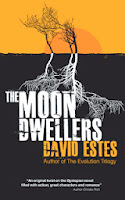
The Moon Dwellers (The Dwellers/Country Saga #1) by David Estes (Self-Published, 2012, 366pp.)

In the first volume of David Estes’s Dwellers/Country Saga, Earth as we know it is over. Due to an environmental cataclysm, people have been forced underground. Now, people live in what’s known as the Tri-Realms. The luckiest live in the Sun Realm (closest to the Earth’s surface) alongside the likes of the system’s dictator-president, Edward Nailin. The not-so-lucky middle-class are stuck in the Moon Realm with terrible living conditions, while the truly desperate are forced to live in the Star Realm, the deepest level of them all. Told from the points of view of its two teenage narrators, the novel chronicles the plight of middle-class waif Adele Rose and Tristan Nailin, the president’s rebellious son, two strangers who are surprised when a chance-glimpse of each other seems to awaken a peculiar connection between them.

The YA genre could definitely use some good science fiction, and The Dwellers/Country Saga is a good place to start. While the action is non-stop, the world-building pretty thorough, and the pacing consistent, the characters, unfortunately, were not given equal chance to develop at the same rate as these other factors. Aside from that, though, it really does make for some exciting reading: with action and love at first sight, there’s enough here to attract both male and female teens. Recommended for Ages 15-18.

Wednesday, September 11, 2013

Interesting High School Drama


Paraestrals, Volume 1: A Vampire’s Awakening by Sara Stenner (Self-Published, 2012, 106pp.)

The first part in a serial novel, Paraestrals: A Vampire’s Awakening takes place in a large city in England, and focuses on Samantha LeFay, a vampire gumshoe. Just fresh out of high school, she co-owns the Paraestrals Private Investigation Service with her best friend. As the story begins, she’s wrapping up a case involving child abduction, when she thinks back on her awakening as a vampire. Like most vampires of pop culture, Samantha enjoys super strength and hearing, but that’s about it in terms of advantages. When Samantha turns 16, she suddenly finds sunlight unbearable. She starts sunburning more easily than the average person, and has to wear long-sleeves and sunglasses in the summertime. No glamor or sparkly advantages here. To be honest? I kept expecting a secret vampire society to swoop down any second and say, “You’ve been accepted to the House of Night/Hogwarts/whatever,” but the truth is, poor Samantha’s adventures as a supernatural creature are actually quite lonely. Her newfound strength freaks out the kids at school, and turns her into a social pariah. As for her bloodsucking tendencies, there’s no one to act as her mentor. Her parents are dead, and all she has left is a snarky stepmom and a beloved half-brother. So, kudos to the author for taking the less-trodden path. 

In technical terms, however, the story still needs some work. It suffers from run-on sentences and an overabundance of adverbs, and there are several instances where the author spells a word correctly, but misuses it. (For example, “I was soar” should be “I was sore.” “She gave me a complement” should be “She gave me a compliment.”) Other than that, it was an interesting high school drama that is sure to please readers ages 14-Up.

Click on cover for image source.

Tuesday, May 14, 2013

Justice League—the High School Edition

High School Heroes (High School Heroes #1) by James Mascia (L & L Dreamspell, 2010, 298pp.)

When Goth-chick Christine starts hearing voices while at school, she fears she may be loosing her mind—until she realizes that the “voices” are actually people’s thoughts. At first, she thinks she’s the only person at Thomas Jefferson High with special powers. Wrong! Turns out that Ethan, her hunky crush and captain of the football team, is the team’s star player for a reason: he has the power of super-speed. After revealing their powers to one another, the two quickly become fast friends. Meanwhile, they discover that two other students have powers: snarky mean girl Savanah (gifted with super strength) and skateboarding loser Peter (able to shoot lightning out of his hands). Then, Ethan has an idea: why not form a super league? (Christine’s initial reaction is less than enthusiastic.) And, as happens with the formations of all impromptu super leagues, the group eventually does come to loggerheads with a villain or two—one of them at Winter Formal, no less.

Been there done that, right? Actually, there’s more to it than that! Not only does the author build up a nice plot, he also pays attention to character development. True, the characters do play off certain stereotypes (the Goth-chick, the jock, the snarky mean girl), yet each of them is distinct in his or her own way. (I can’t tell you how pleased I was when Ethan, who, when we first meet him,seems to be a typical jock, is actually a really nice, smart guy who likes to drag his friends to ComicCon.) Overall, an enjoyable read.

The adventures of Christine and her friends in High School Heroes is the foundation for Mascia’s High School Heroes series. At least three more volumes will follow. Recommended for Ages 15-Up.

Click on cover for image source.

Thursday, January 17, 2013

Macbeth: 2013

Source: Author Website
Exposure (Twisted Lit #2) by Kim Askew & Amy Helmes (Merit Press, 2013, 224pp.)

In the second installment of the “Twisted Lit” series, Shakespeare’s Macbeth is relocated from medieval Scotland to a modern-day high school in Anchorage, Alaska. Wallflower Skye Kingston, photographer for the school newspaper, is content to quietly crush on her friend, Craig MacKenzie, one of the populars and a member of the hockey team. It’s all she can do, really, since he’s already been claimed by Beth, one of East Anchorage High’s most imposing Queen Bees. Skye’s life takes a turning point when she attends a wild, off-campus party where Duncan Shaw, the hockey team’s captain, meets an unfortunate end. (The meaning of the title— “Exposure”—will become evident when the reader finds out how he died.) For most of the high school, Duncan’s death is shrouded in mystery, but three students alone know the truth—Craig and Beth, who perpetrated the deed, and Skye, who overhears their frantic conversation after the event takes place. Skye tries to be supportive with Craig, but he becomes increasingly hostile with her and others. Should Skye stay loyal to her friend and keep her silence, or should she go to the police?

I have to admit, at first glance, I was a bit mystified as to how the authors would manage to follow-up their first novel, the romantic comedy Tempesutous, with a novel based on a classic tragedy filled with violence, suicide, greed, and murder. However, Exposure manages to provide an interesting variation of its origin story without being too glib or too dark. In the original play, Macbeth, the Thane of Glamis and servant to King Duncan, is confronted by three witches, who predict that he will soon be king. When it turns out that this won't happen in the near future, his ambitious wife, Lady Macbeth, decides to speed things along, and goads her husband into murdering Duncan while the royal party spends the night at their house. In Exposure, the death turns out to be accidental, and happens entirely off-screen. As for the three witches, they make a sort of cameo appearance as Skye’s friends, a trio of teens of Yup’ik (Eskimo) descent who are making tribal masks for a school project. As they explain:
“Our ancestors were Yup’ik people... One of their traditions was to carve masks like these for ritual dances. The masks were embodiments of a spiritual vision, and they were said to imbue the wearer with the spirit they represented.” (22)
Overall, a solid, teen-friendly version of Shakespeare’s tragedy. In fact, I think I actually like Exposure more than Tempestuous. I am definitely interested in seeing what else this series has to offer. Recommended for Ages 15-17 for Language.

Tuesday, December 18, 2012

The Tempest: 2012

Source: Author Website
Tempestuous (Twisted Lit #1) by Kim Askew & Amy Helmes (Merit Press, 2012, 224pp.) 
“Anyone who says leprosy is a disease that’s been eradicated hasn’t set foot in a high school lately.” (64)
For Miranda Prospero, a former member of Eastern Prep’s elite “in-crowd,” life has become boring, but not exactly unbearable. Just recently, the school administration discovered that she and her friends were running a secret matchmaking service that paired up geeks with the academically challenged cool kids (for a price). To save their own skins, her boyfriend and friends produced Miranda as the ringleader of the operation. The school demanded that Miranda pay back all profits she earned from her little business, so at present, she finds herself sentenced to minimum-wage labor at a greasy hotdog stand at the local mall.

But things aren’t so bad. She’s managed to make some friends her own age there, including Ariel, her sweet, cheerful manager/co-worker; Colin, a waiter who works in the hell that is Cheeze Monkey Pizzeria; and Caleb, a brooding, frustrating, yet incredibly attractive game-store employee. Shortly after the story’s beginning, Miranda, her new friends, and a handful of other teens (including her now ex-boyfriend and a few other treacherous classmates) get snowed in by a massive blizzard. Since Miranda had planned to throw a surprise birthday party for Ariel, she and her friends unleash the festivities in the mall—and at the same time, take vengeance on her former in-crowd compatriots by increasingly juvenile means (tormenting a girl terrified by rabbits in an elevator with a pet-store bunny; asking Ariel to lure a few “mean girls” into the mall beauty salon and give them bad makeovers.). The fun turns sour, though, once they realize that a dangerous assailant is trapped in the mall with them—someone who steals mall merchandise and then acts violently when someone tries to catch him in the act.

Tempestuous, the first book in a series that plans to focus on putting a “modern-day spin” on Shakespearean literature, centers on the comedic play The Tempest. For those who haven’t read it, Tempest takes place on an enchanted island where Prospero, the bookish, exiled Duke of Milan, now spends his time dabbling in magic. His only companions are his daughter, Miranda; Ariel, his faithful spirit-servant; and Caliban, the crafty, deformed monster-servant intent on betraying him and claiming the island for himself. When a ship carrying the makers of his social undoing—Alonso, king of Naples; Duke Antonio, Prospero’s usurper brother, and others—comes within distance of his island home, Prospero decides that he wants revenge and creates a storm to shipwreck everyone on the island. He then spends the rest of the story leading the castaways through a series of tests to call them out on their past transgressions, leading them to see the error of their ways. He then gets his old job back, and he even manages to arrange a marriage between his daughter and the king’s son, Ferdinand.

Tempestuous proves to be a very faithful, if at times, somewhat problematic interpretation of the Bard’s work. In this updated version the authors have combined Prospero, the original magician, and his daughter Miranda to make the story’s hero young and female. Like her literary component, the YA novel’s heroine “works magic” by matchmaking, manipulating situations to her liking, and punishing her enemies— though in her case, it seems like each prank is carried out in a fit of mean-spirited vengeance against clichéd villains rather than with the well-meaning spirit of the Bard’s comedy.

This isn’t to say that Miranda herself doesn’t gain some sense of humility in the end, however. As she sheepishly admits at the conclusion of her adventures: “Justice [is] always preferable to petty revenge” (169).

Knowledge of the origin material gives the story’s somewhat silly and extravagant antics a degree of credibility, though taken as an original standalone piece, readers more interested in “reality-based” fiction may call their suspension of disbelief into question. But, now that I think about it, I can’t really image many teens interested in anything remotely “reality-based.”

Who will enjoy it? I think I can safely say that this book will appeal to shy, young loner-types who feel they don’t fit in, who enjoy a light read on occasion, and who love seeing snooty popular kids reduced to caricatures. Reading The Tempest isn’t required to get the overall gist of the story, but as a former English major, I can’t resist urging those unacquainted with the Bard to rent a copy of it. Recommended for Ages 15-17 for Language.

Wednesday, September 5, 2012

The Day that Music Died

Source: Publisher Website
Death of a Dreamer: The Assassination of John Lennon by Alison Marie Behnke (21st Century, 2012, 112pp.)
 
In six chapters and a little over 100 pages, Death of a Dreamer deals with a whirlwind of interrelated topics: tumultuous political climate of the 1960s, the life and death of the late great John Lennon, and Mark David Chapman, the man who would stalk and murder one of the era’s most influential musicians in cold blood.

Placing an age range for this book is problematic. Based on the picture-book layout, one could say that it’s targeted at children and young adults, especially since it goes out of its way to define terms like ASSASSINATE, GIG, and CAPITALISM. However, the process of plowing the chapter on capitalism’s battle against communism will definitely lose the attention of anyone in the 9 to 12 age range. It also covers more “adult” topics, such as Chapman’s depression and questionable mental state, and Lennon’s drug use and posing nude for Annie Leibowitz. The slow pace of these beginning chapters will require the reader to have the patience of a young reader who doesn’t mind wading through the slow parts. The ending, however, is quite dramatic. Like any Beatles fan, I actually found myself gripped and somewhat saddened by the book’s narration of Lennon’s final hours. An ambitious work for a semi-picture book of only 112 pages, it will be of particular interest for anyone who’s interested in, as I like to call it, the day that music died. Recommended for ages 12-18 who have an attention span that lasts longer than 10 seconds.

Monday, June 4, 2012

Somewhat Amusing, but Ultimately Unpolished


Narrative Loserdom: (From Journal One) by Ryan Collins (Self-Published, 2011, 204pp.)

A fictional diary written by the character Justin Taggart, a 15 year old Texan boy who--let’s face it--may be a bit of a loser at school. Written in episodic spurts from July 2001 to July 2002, he chronicles his misadventures with his friend Adam, in which they invent new ways to steal TV cable, try to break into a Coke machine, and run a lawn-mowing service.

The diary format of the story definitely works, but with some flaws. While the writing style is very much consistent with the abilities of an aspiring writer, there’s too much description and explanation for the reader’s benefit, considering the narrator is writing out his thoughts by hand. In terms of character, we never really get to know anyone beyond Adam and Justin, so the protagonist’s half-hearted documentation of his high school crushes seem a bit pointless. With a very abrupt ending to conclude the story, Narrative Loserdom comes off as a somewhat amusing, but ultimately unpolished work. Recommended for Ages 15-17.

Click on cover for image source.

Friday, May 25, 2012

A Great Horror Story


The Boo Hag (The Lenny Chronicles #1) by David Morgan (Self-Published, 2012, 328pp.)

Boo Hag (n): a creepy, skinless female demon from folklore that preys upon humans by stealing their skins and then masquerading as the now-deceased—at least until it’s time for a new wardrobe.

Is your skin crawling yet? Just be glad you’re not Lenny Petrakas. Lately, she’s been having problems with one of these pesky demons who just can’t seem to take a hint! Fortunately, she’s got a few loyal friends who are as determined as she is not to let that happen.

Reader, you will be glad to know that this isn’t your usual horror story. In your standard fare, the hapless heroine does all sorts of stupid things to advance the plot. You know, the kind of moments that will either make you cry, “Don’t go in there!” or “Ha, ha! You’re going to get it!”, depending on whether or not you actually care about the characters. In the case of Morgan’s leading lady, Lenny at least goes armed with her wits and a hockey stick.

The story’s pacing is fairly quick, and although the suspense is sometimes slackened by pointless scenes of Lenny’s friends swooning over their crushes (get back to the boo hag, already!) the novel ends on a cliffhanger that will guarantee your interest in any sequel. The Boo Hag will appeal to teens of any age who like scary stories, as well as fans of Buffy the Vampire Slayer.

Click on cover for image source.

Friday, May 11, 2012

Convincing Treatment of the Well-Worn Doomsday Scenario


Source: Author Website
The Faustian Host (Apocalypse Signs #1) by Dave Becker (Self-Published, 2012, 221pp.)
 
After his religious nutcase grandmother dies, teenage Tony Marino is sent to live with foster parents in Clement, Massachusetts, where he is given the opportunity to attend an exclusive private school. Kalos Academy is sort of like Hogwarts if Hogwarts was A) American B) a private day school C) not overtly magical and D) catered to children whose IQ is off the charts. To attend Kalos, you’ve got to be smart. Really, really smart. Class attendance is encouraged, though not required. There’s no grading system, only a pass/fail option.

Although he has a rocky start at first, Tony feels like he’s finally settling in—of course, this is before weird things start happening. In religion class, he touches an ancient scroll the teacher has on display for the students—and it bursts into flames! On a class fieldtrip to Plymouth Rock, the historical stepping stone bleeds and stains Chesapeake Bay a dark red. Later, the town of Clement is set upon by swarms of flies. Since Clement was a relatively normal little town before Tony the New Kid’s arrival, his classmates naturally think he’s cursed. But Tony doesn’t believe in that kind of nonsense. Of course, this being a fantasy story, there has to be a little bit of magic—just not the Hogwarts kind. Actually, it’s more of the Satanic-doomsday-cult kind. And the cult is after Tony.

The Faustian Host
is definitely an interesting story. Becker’s descriptions of Kalos build a colorful picture of a unique academic institution that will make public school students envious, and his treatment of the well-worn doomsday scenario is convincing. However, it’s not without its flaws. The overall pace of the novel feels somewhat rushed, and the cast of supporting characters is left underdeveloped. Although apologies must be made for mentioning Harry Potter, comparisons become somewhat inevitable as the plot develops. A restless young man plucked from obscurity, Tony is sent to a special school and turns out to be “the Chosen One.” Pursued by a Death-Eater-like cult, he is later entrusted with the safekeeping of an all-powerful ancient artifact. However, despite these technical criticisms, teens eager for new urban fantasy/adventure epics will definitely enjoy what they find here. Recommended for Ages 14-16.